M. FORD CREECH ANTIQUES & FINE ARTS
WILLIAM GILBERT GAUL Tennessee / California / Jersey City, NJ 1855-1919
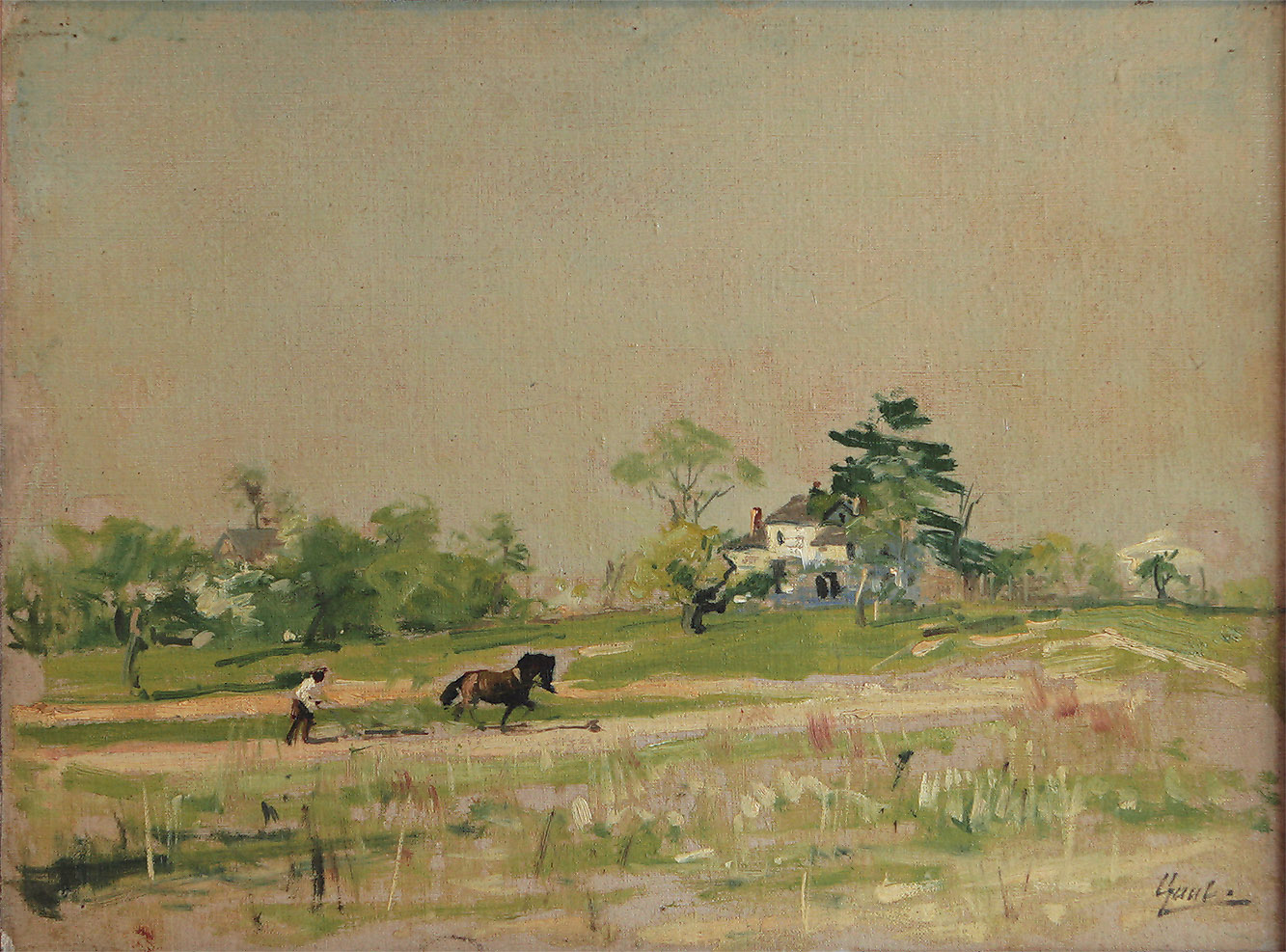
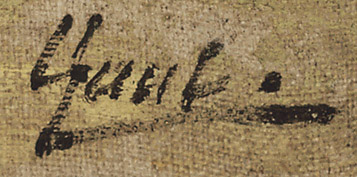
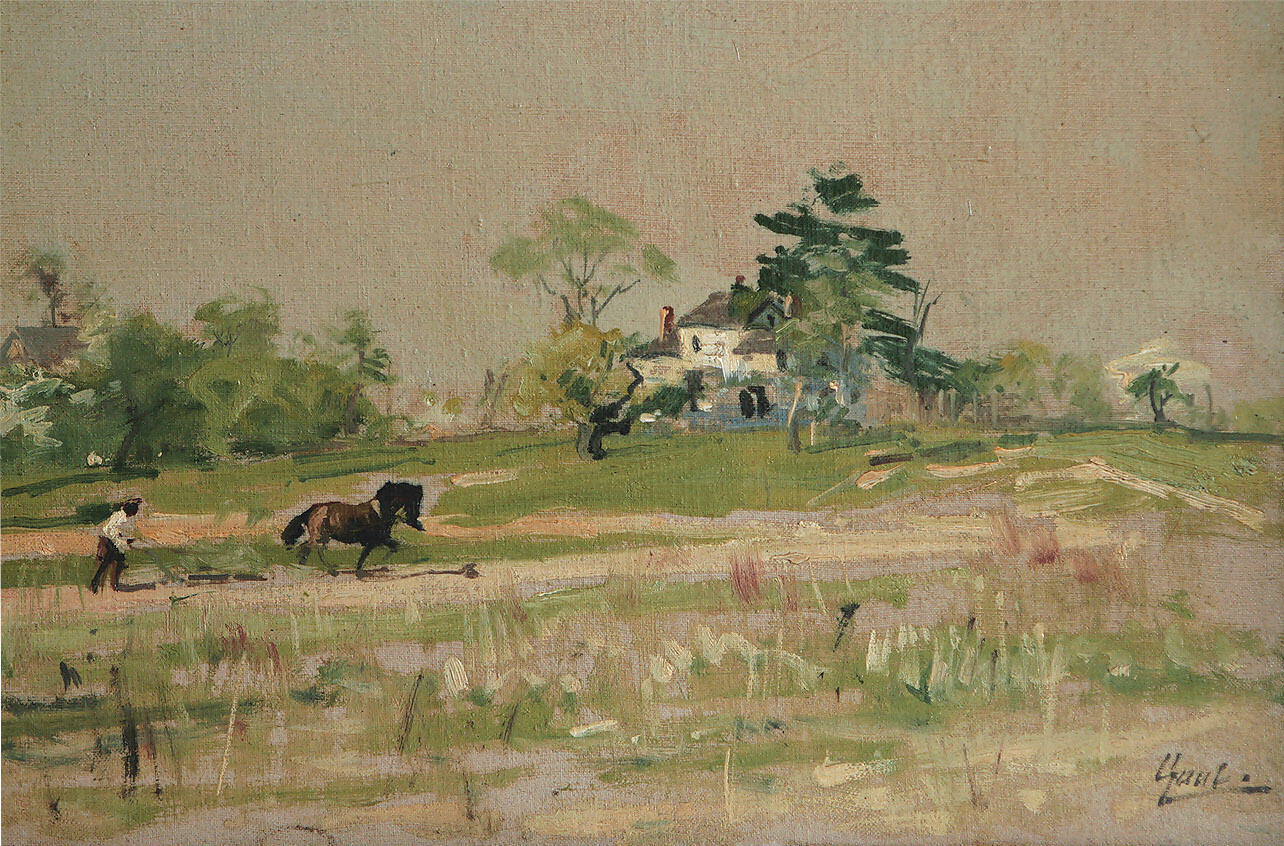
“SOUTHERN LANDSCAPE” Oil on Canvas Mounted on board Signed “Gaul .” l.r. Housed in a green lacquered wood frame
Provenance: Oceanside Museum of Art, Oceanside CA, bearing label verso
Museums: 24, including National Portrait Gallery, The Corcoran Gallery of Art, New York Historical Society, Oakland Museum of California, High Museum of Art, Cheekwood Museum of Art & Botanical Garden, Yale University Art Gallery
Books: 73, including James Gilbert Gaul: American Realist, Hoobler;,L'Heritage du Tennessee: L'Oeuvre de Gilbert Gaul et la Guerre de Secession Americaine, Hobbler
Periodicals: 3 (Before 2007) – American Art Review
Image Size: 12" x 16”
SOLD
#6085
Signature Lower Right :
Detail of Brushwork :
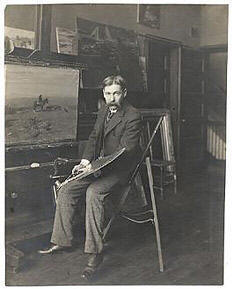
Gilbert Gaul in his studio
Birth place: Jersey City, NJ Death place: NYC Addresses: NYC; Fall Creek Falls, TN Profession: Painter, illustrator, teacher
Studied: Claverack Military Academy; Acadámie Julian-Student; National Academy of Design, 1872, with L. E. Wilmarth; Art Students League; J. G. Brown, in NYC; Art Students League, 1875
Exhibited: National Academy of Design, 1875 (his last name was misspelled as Gault), 1877-1900, 1906-19; Brooklyn Art Academy, 1877-86; Boston Art Club, 1881-98; American Artists Association., 1882 (gold medal); Prize Fund, 1886 (gold); Art Institute of Chicago; Paris Expo, 1889 (bronze medal); Pennsylvania Academy of Fine Art, 1890, 1893-94; Columbian Expo, Chicago, 1893 (medals); Pan-American Expo, Buffalo, 1901 (medal); Appalachian Expo, Knoxville, 1910 (gold medal).
Member: Associate National Academy, 1879; National Academy, 1882; Salmagundi Club, 1888.
Work: Oakland Museum; Toledo Museum of Art; Democratic Club, NYC; Gilcrease Institute, Tulsa; Peabody Institute, Baltimore; C. R. Smith Collection; Tennessee State Museum (See list below)
Comments: Born William Gilbert Gaul. An historical illustrator of the Civil War and Native American life in the Old West. His best known collection of illustrations appears in Battles and Leaders of the Civil War (Century, 1887). He made his first trip West in 1876; thereafter he became increasingly fascinated with the Native American tribes and painted on Indian reservations throughout the 1880s. During this period he kept a studio at the Tenth Street Studio building. In 1890, he took a census of the Indians and illustrated the Report on Indians Taxed and Indians Not Taxed. Gaul became a teacher at the Cumberland Female College in McMinnville, TN, in 1904, and in 1905 he had a studio in Nashville, where he published a portfolio by 1907. Soon after that he went to live in Charleston, SC, and by 1910 he was in Ridgefield Park, NJ, where he did World War I battle paintings before his death in 1919.
Sources: WW21; Hughes, Artists of California, 202; P & H Samuels, 184; Kelly, Landscape and Genre Painting in Tennessee, 1810-1985," 90-93 (w/repros.); Falk, Exh. Record Series. This biography is drawn from the "Who Was Who in American Art" , the reference book on the cultural life in the United States.
Collections: Anschutz
Collection
Museums (24):
GILBERT GAUL IN TENNESSEE
Gilbert Gaul’s mother was a Tennessean. At her brother Hiram Gilbert’s death, Gilbert inherited about 5,000 acres in the area of what is now Fall Creek Falls State Park in Van Buren County, TN, in the rugged Cumberland Mountains. He was required to live there 5 years according to the will. He converted a barn into a studio, and later built a cabin on the land. During that period, he painted many locals in the surrounding area, using natives of the region as his models, both in indigenous clothing and in uniform. Some of those paintings included “Leaving Home”, chronicled in the Van Buren County Historical Journal, Volume 2, published in 1982; "Tidings from the Front"; and "The Pickett", said to be one of his finest Civil War paintings. Various families still report their relatives and homes, as depicted in detail in Gaul’s works.
After his 5-year resident requirement in Van Buren County, Gaul returned to New York City. The work he had done in Tennessee became highly sought after by the editors of "Century Magazine" and "Harper's Weekly", for whom he provided covers, frontispieces, and illustrations to articles. He was a contributor of illustrations to the Century Publishing Company's ambitious three- volume set "Battles and Leaders of the Civil War" (1887). In 1886, the Philadelphia publisher J.B. Lippincott invited artists whom they considered the United States' leading contemporary figure painters each to contribute an original work of art for reproduction in "Book of American Figure Painters". Gaul, being among those so honored, depicted "John Burns at Gettysburg" for the collection.
In 1898, Gaul returned to Van Buren County with his second wife, the daughter of Admiral Halstead of the Royal Navy. Shortly thereafter, Gaul’s work fell out of favor, forcing financial hardship upon him, and leading him to seek teaching positions for the first time in his life. He taught at the Cumberland Female College in McMinnville, Tennessee until 1905, when he joined the faculty of the Watkins Institute in Nashville. He made his home and studio above a dry goods store at 610-1/2 Church Street, where he also offered private
classes. While there, he also illustrated about a half-dozen novels by
author Thornwell Jacobs of Nashville.
In 1907 the Southern Art Publishing Company was formed in Nashville for the purpose of publishing "With the Confederate Colors", a series of chromolithographs illustrating still-living military persons from the Civil War. Gaul was called upon to provide twelve original paintings for the project. Some of these had been painted years earlier, including "Holding the Line at All Hazards", the painting that had earned him a gold medal in 1881. Others were "Leaving Home", "Waiting for Dawn", "Playing Cards Between the Lines", "The Picket", "The Forager", and "Tidings".
Gaul, at that time, was the only southerner then part of the prestigious National Academy.
(Of further interest, Gaul was commissioned as a special agent of the United States census of 1890 to visit the Cheyenne and Standing Rock Indian Reservations in North Dakota. There he sketched Sitting Bull only a few months before the chief's death. The portrait was published in the official report of the census, as was "Sioux Camp", also by Gaul.)
We welcome and encourage all inquiries regarding our stock. We will make every attempt to answer any questions you might have.
For information, call (901) 761-1163 or (901) 827-4668, or Email : mfcreech@bellsouth.net or mfordcreech@gmail.com American Express, Mastercard, Visa and Discover accepted
M. Ford Creech Antiques & Fine Arts / 581 South Perkins Road / Memphis, TN 38117 / USA / Wed.-Sat. 11-6, or by appointment
|