The Small & Jewel-Like
"It must be noted that in all ages, while the
public has been fascinated by the large, the imposing,
(Home Page: www.mfordcreech.com)
Full Category Links: Accessories / Ceramics / Early Asian / Fine Art / Furniture / Glassware / Silver
|
|
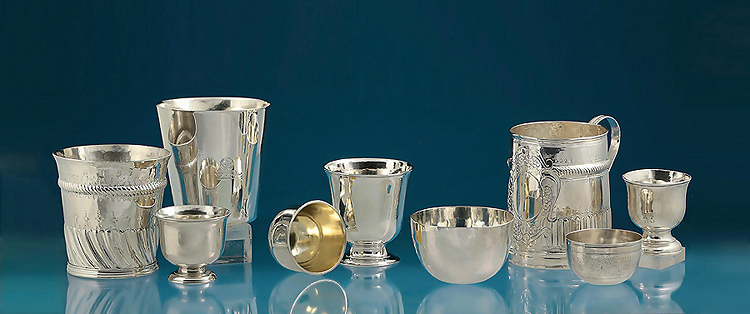
In The Company of "Small Cups" Click For 'A Catalog Featuring A Few Small British Drinking Cups, c1690-1774'
|
|
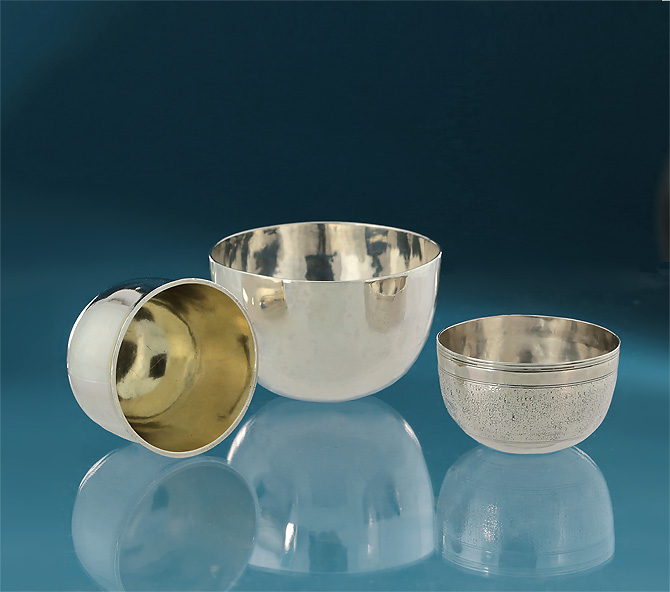
One of the earliest records of tumbler cups is that of Samuel Pepys, on October 24, 1664. The earliest silver known tumbler cups still in existence date to 1671, at All Souls Oxford.
Three Early Silver Tumbler Cups, c1690-1731 (Left to Right) : George I Silver 'Tumbler Cup', James Goodwin, London, 1723 Early George II Silver 'Tumbler Cup', William Allen I (likely), London, 1731 (SOLD) James II / William & Mary Small Silver 'Tumbler Cup', Roger Strickland, London, c1690
|
|
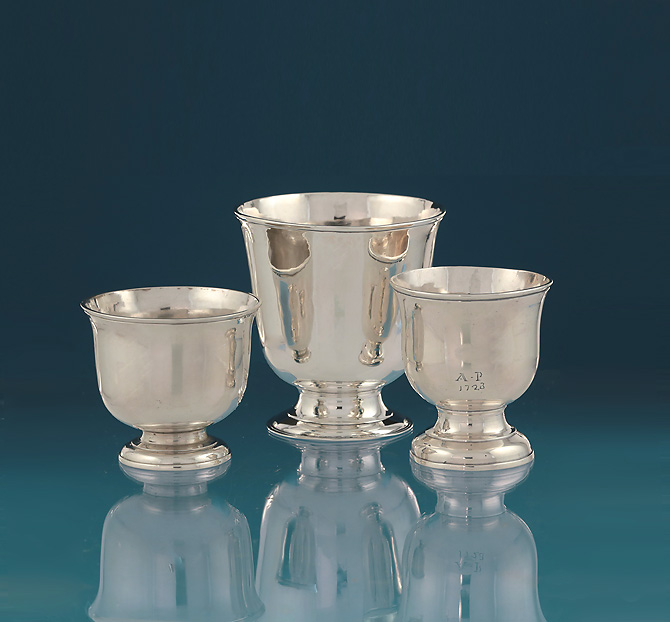
"Tot cups" are small drinking vessels, sometimes with a single handle, or handleless, in beaker form. They are usually footed and dram size (about two inches). Tot cups are said to be predecessors of the later Georgian “stirrup cups” - so popular in both silver and ceramic from the mid-18th century forward. Tot cups, like stirrup cups, were likely handed to riders before or after a hunt, and meant to be drunk without putting the vessel down. Early silver tot cups of any form are scarce, if not rare.
Three Early Georgian Silver Tot Cups (Left to Right) : Scarce Early George II Silver "Tot Cup", Thomas Parr II, London, 1730 Scarce Early George II Silver 'Tot Cup', William Paradise, London, 1732 Scarce George I Silver 'Tot Cup', 1724, Scratch-Initialled 'AP 1723' (SOLD)
|
|
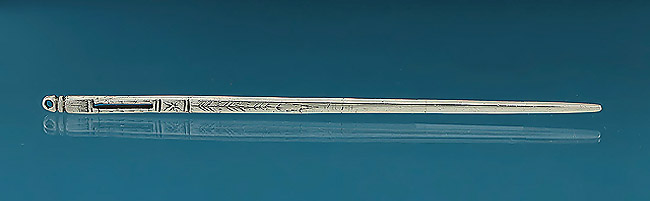
Elizabeth I / James I Silver Bodkin Unmarked, England, c1600-1620 The tapering stem with an elongated hole for ribbons, 5.4" Long / 0.4 oz SOLD
|
|
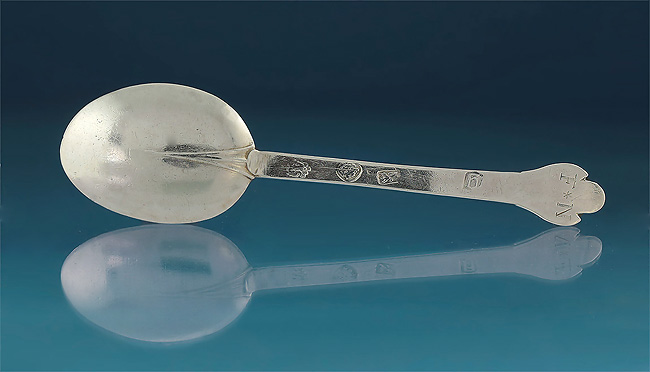
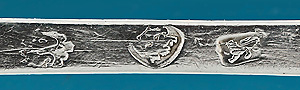
Charles II Silver Child's Trefid Spoon Steven Venables Junior, London, 1684 Of good gauge silver for the period,
|
|
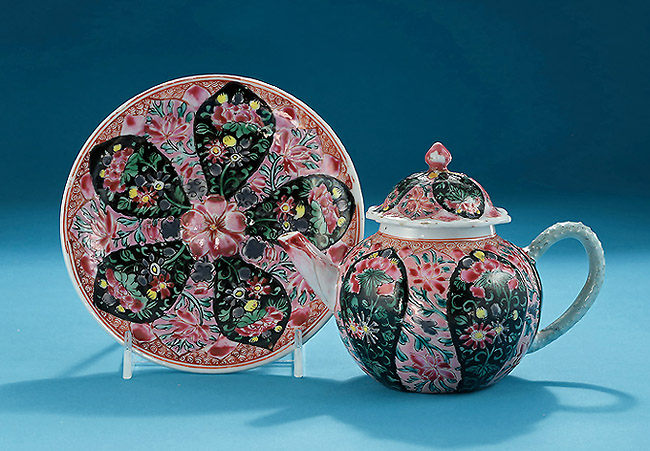
Yongzheng Famille Rose & Black-Ground Moulded Teapot, Cover & Stand China,1722-35 The moulded teapot and stand with black-ground lotus petals on a famille rose ground,
|
|
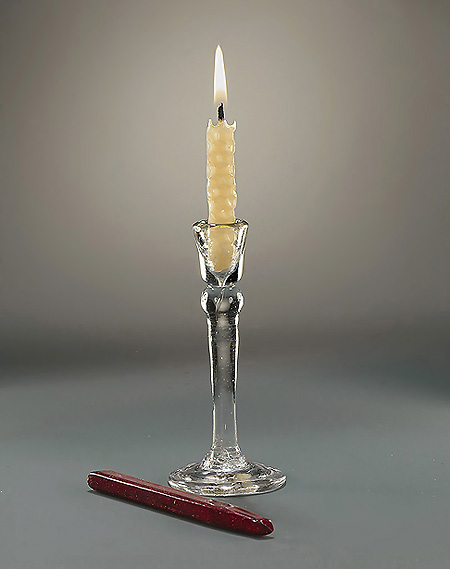
Rare George I Glass Taperstick A rare and early example, intended for heating sealing wax for letters, SOLD
|
|
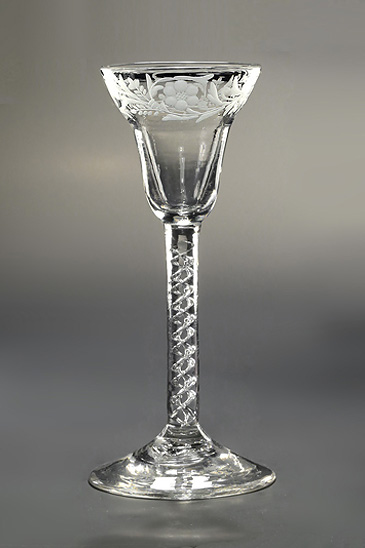
George II Engraved Pan-Topped 'Mercury Twist' Wine Glass The pan-topped bowl having an engraved floral border to the rim,
|
|
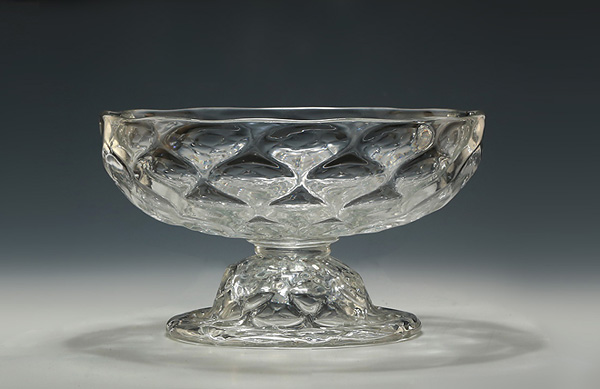
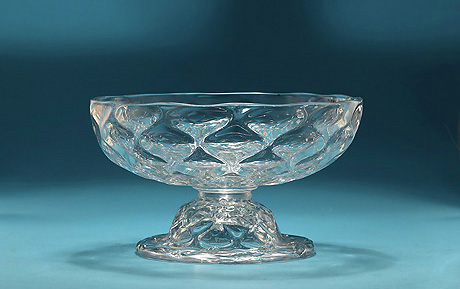
Scarce George II Honeycomb-Moulded Footed Glass Bowl England, c1730 The heavy circular blown glass bowl moulded all over with honeycomb decoration above a short stem and high domed and honeycomb-moulded folded foot with snapped pontil 3.5" High / 6.5" Diameter / 17.9 oz.
SOLD
Although many today think of 'honeycomb moulded' glass as being of the late 18th and 19th centuries, 'pattern-moulded' glass vessels have existed from the Roman era, including their prized 'honeycomb moulded' bowls. Mould-blown patterned glass, including 'honeycomb', was continued by 15th-17th century Venetians, particularly as cups and tazzae. The 'honeycomb' pattern is also known in 17th century England, a version of which led to George Ravenscroft's 'nipt diamond waies' glasswares, in which vertical ribs (or applied threads) were 'nipped' into diamond shaped with pincer
|
|
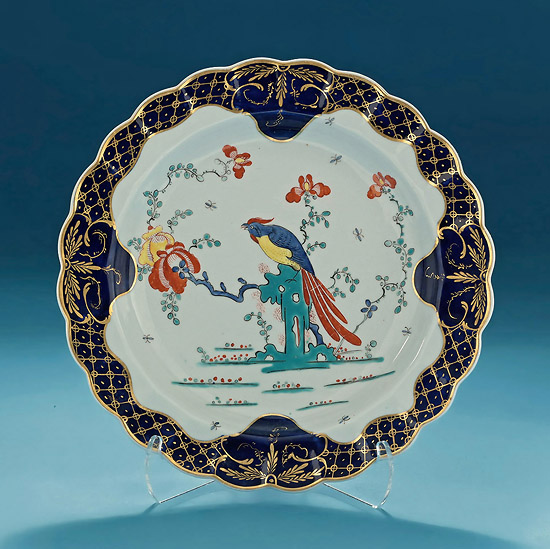
Fine First Period Worcester Sir Joshua Reynolds Scalloped Deep Plate
The connection between this pattern and Sir Joshua Reynolds is unclear,
|
|
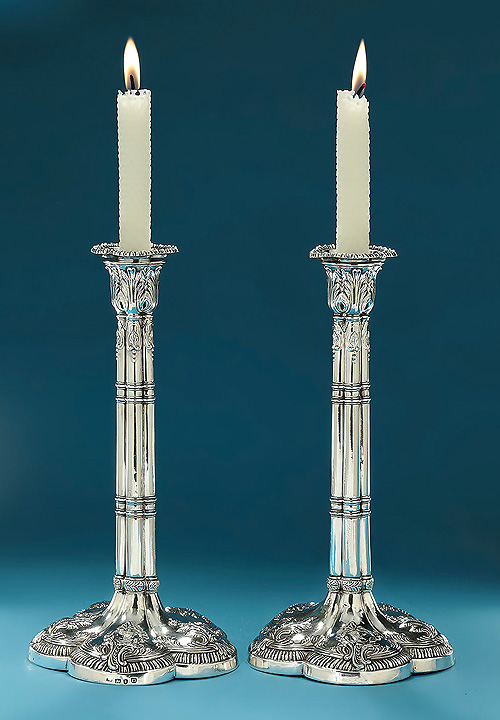
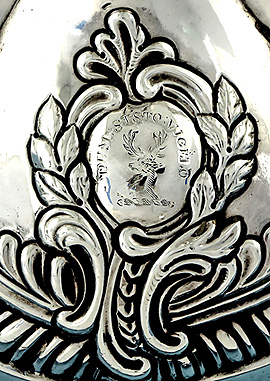
Pair George III Silver Clustered-Column Candlesticks William Cafe, London, 1768 for the Dukes of Gordon, from Letterfourie House (by Robert Adam) A truly impressive design reflecting 17th century Huguenot design, 'A Hart's Head Couped ppr.', and Motto : 'Dum Sisto Vigilo' 12" High / The Foot, 6.25" Wide
|
|
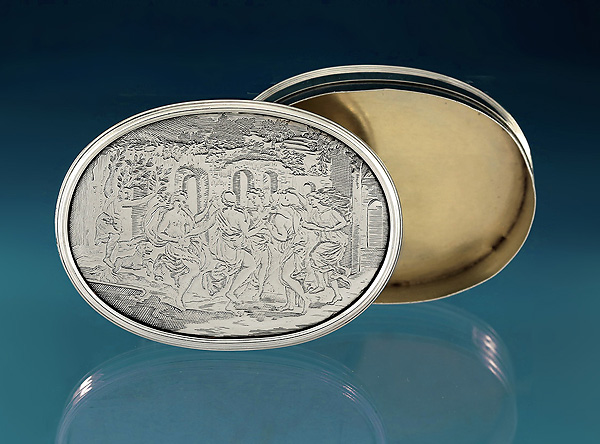
George I Engraved Silver Snuff Box, Classical Scene England, Unmarked, c1720-1725 The very heavy gauge silver box of usual early 18th century oval form 2-5/8" Long / 2.3 oz.
|
|
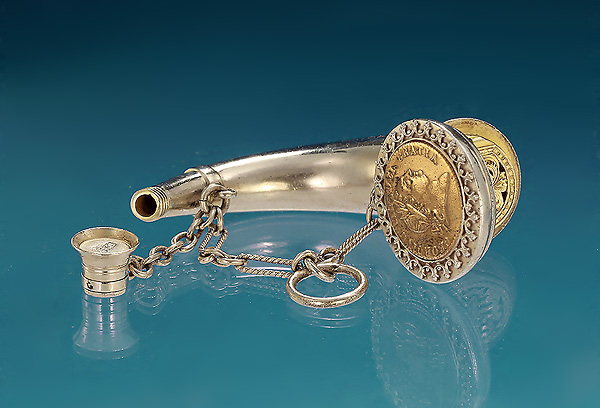
Victorian Silver Hunting Horn Vinaigrette & Scent Flask
|
|
|
|
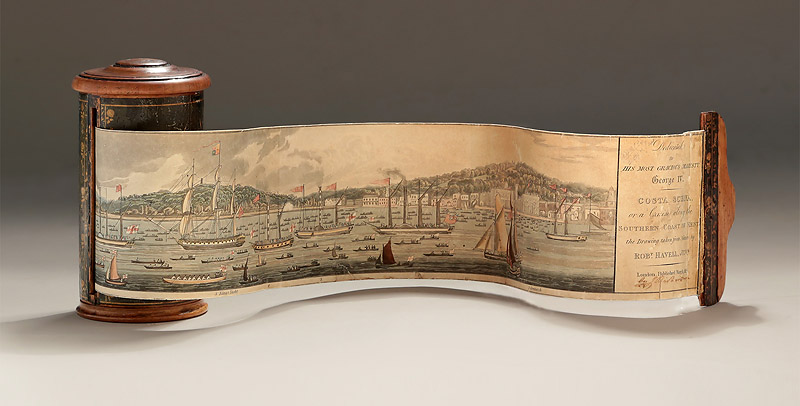
Costa Scena : A Cruise Along the Southern Coast of Kent aboard the 'Royal George'. SOLD
|
|
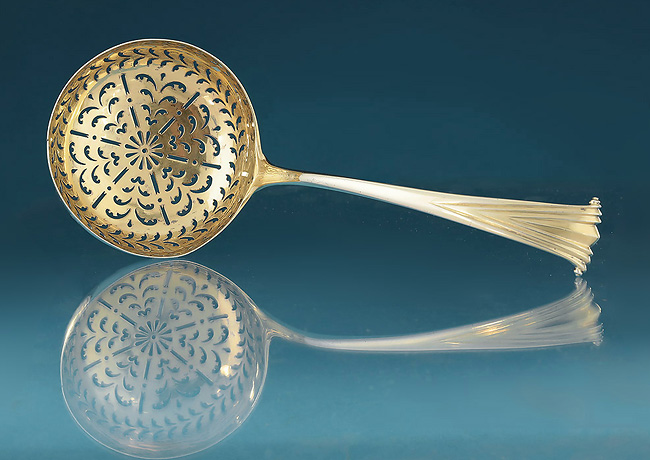
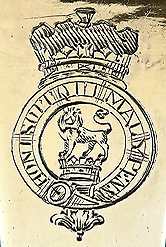
Royal Interest : George III Large Silver-Gilt Onslow Straining or Sifting Ladle, Crested for Son of George III (Prince) Unmarked, c1775 The unusually large ladle of heavy gauge silver, for sifting or straining,
SOLD
|
|
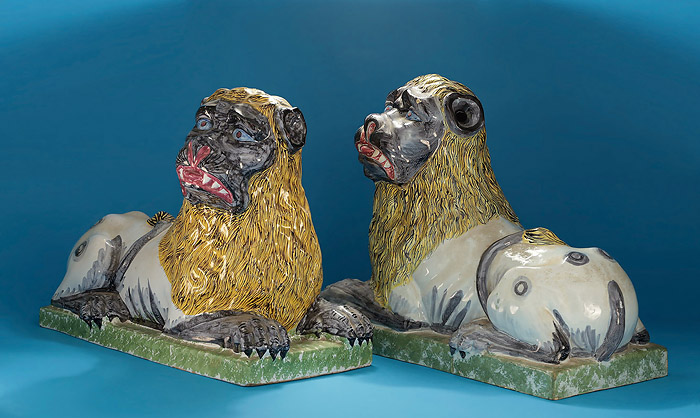
Rare Pair of French Faience Polychrome Seated Lions Probably Luneville, c1800 Whimsically painted in shades of black, gray and violets, with black-lined yellow manes, 18" Long x 14" High
|
|
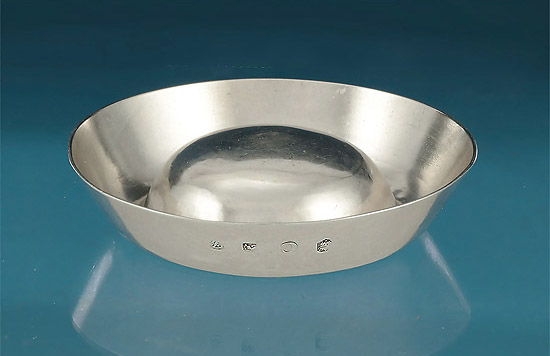
Rare George II Silver Saucer-Form Domed Wine Taster In the "Bordeaux" circular saucer form,
|
|
|
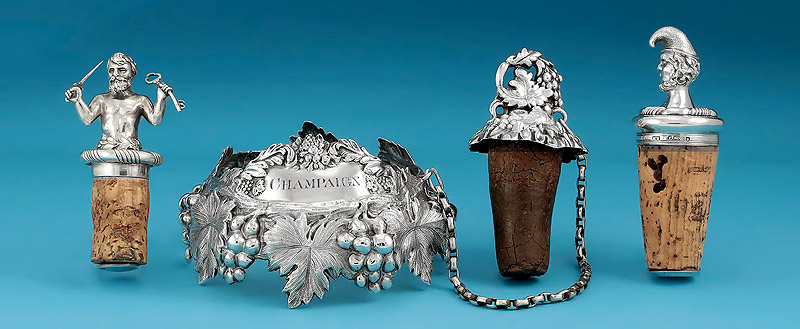
Three Fine Silver-Mounted Bottle Stoppers : Left to Right :
Fine Victorian Cast Silver Heraldic Bottle Stopper, Murray, Dukes of Atholl (or Athole) and the Earls of Dunmore (Hennell) SOLD
Good George IV Silver Bottle Neck Ring and Silver-Mounted Bottle Stopper (Samuel Jackson) SOLD
Victorian Cast Silver Heraldic Bottle Stopper Bouchier, Earls of Essex and Ewe, & Barons of Bouchier (William Hunter) SOLD
|
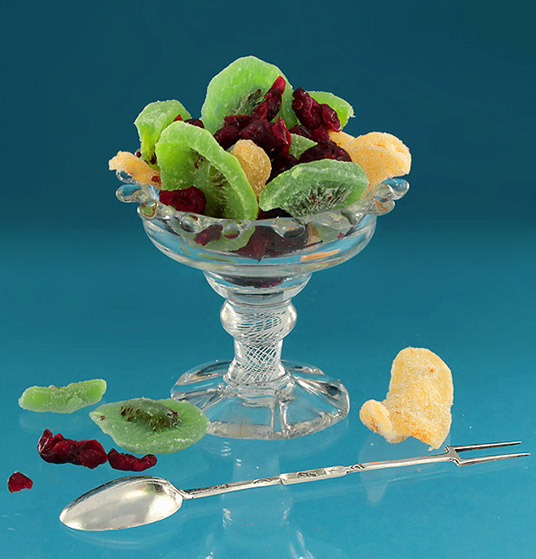
George II Glass Sweetmeat Dish, c1750, filled with candied citrus and cranberries, having a dentelated rim and oversewn foot Shown with A William and Mary Silver Sucket Fork Adam King, London, 1691 (The Fork Sold)
|
|
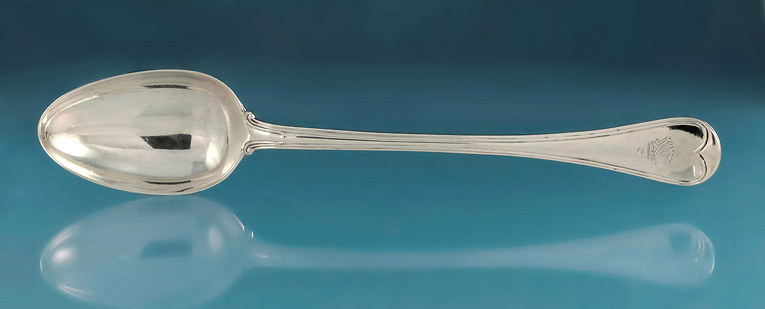
Fine William IV Silver Military Thread Basting Spoon Paul Storr, London, 1835 Crested for the family of Astley Of heavy gauge silver, as expected with Storr wares, the rare 'Military' variant of 'Old English Thread', 12.5" Long / 6.1 oz
|
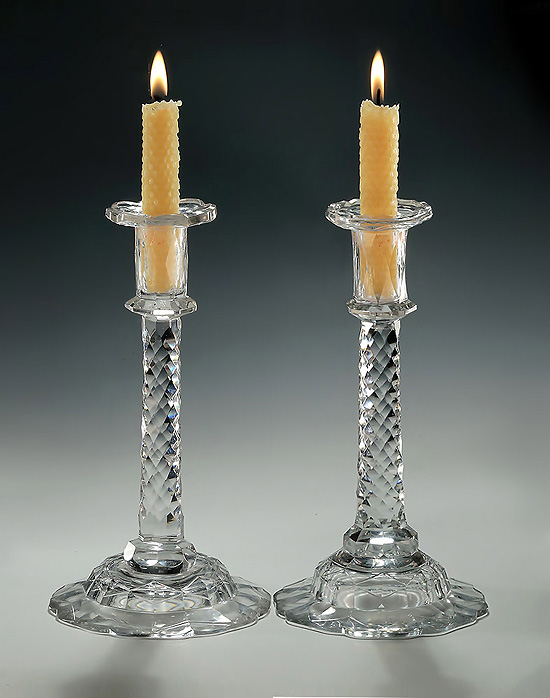
Pair of George III Facet-Cut Glass Candlesticks England, c1770 Of fine quality, flat-cutting and weight,
|
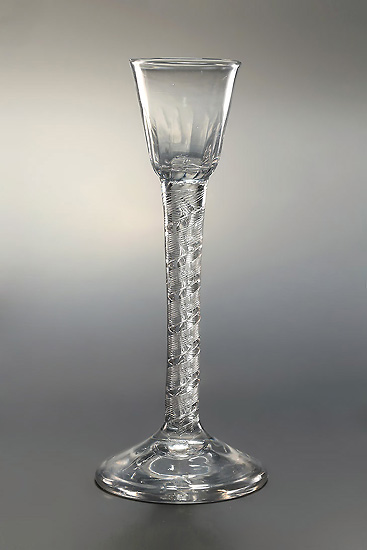
George II Airtwist Cordial Glass A quite heavy glass, having a round funnel bowl with fluted lower half,
|
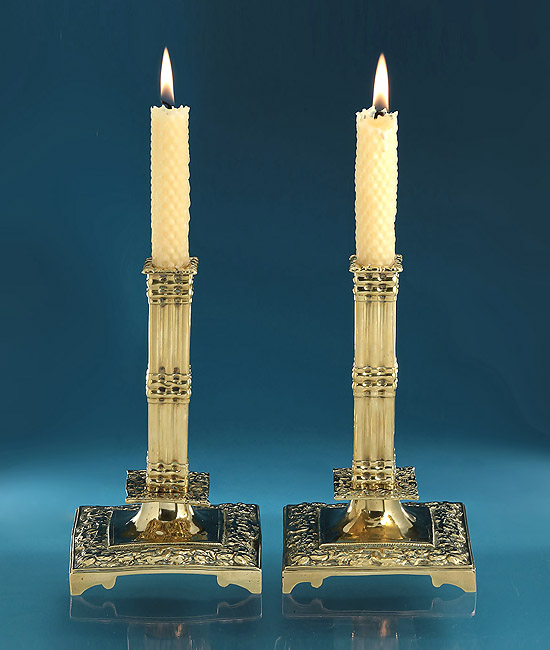
Pair Brass &Sheet Brass Column Culstered Candlesticks Netherlands, c1675 Showing Huguenot influence and cluster column design, SOLD
|
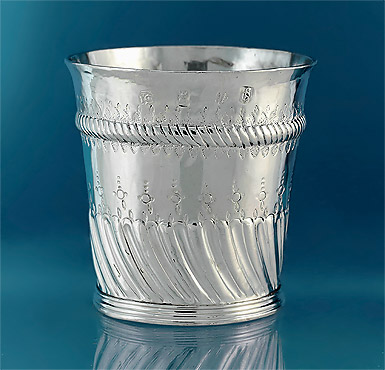
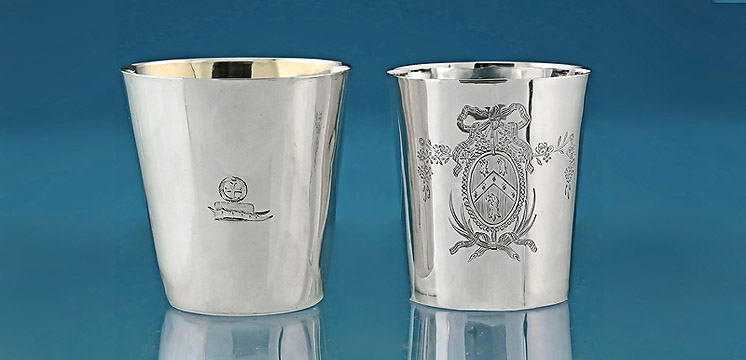
Cylindrical 'BEAKERS' date back at least 6000 years - abundant in Biblical times. However, silver beakers are comparatively rare from Queen Anne period :
Queen Anne Britannia Silver Beaker 3” High / 3.8 oz.
Aaron Lestourgen, London, 1774 Of tapering cylindrical form, with gilt interior; Crested for the family of Kirkby of Northwest England : Willliam Comber Kirkby (Lancashire and Surrey), or his son William Kirkby (Co. Middlesex) 3.25" High / 4.8 oz. SOLD
Charles Wright, London 1775 With arms for an unmarried daughter of the Browne family, Suffolk and Essex. (likely either Anna Marie Browne or Charlotte Browne of Suffolk, prior to marriage) 3” High / 2.8 oz. SOLD
|
|
||||||
|
|
||||||
 |
|
 |
||||
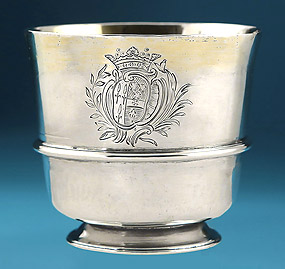
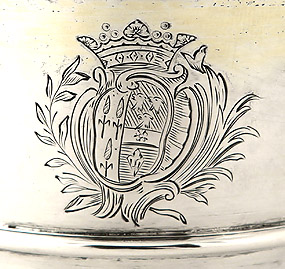
William & Mary Silver Tot Cup The small girdled cup cup bearing the marriage arms of a Continental Marquis; 2-3/8" High / 3 oz.
Tot cups are small drinking vessels, sometimes with a single handle, or handleless,
in beaker form. SOLD
|
||||||
|
|
||||||
|
||||||
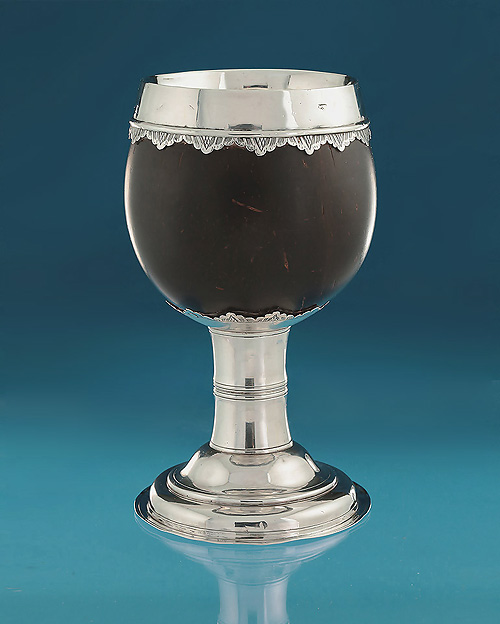
George III Scottish Provincial Silver-Mounted Coconut Cup
William Young, Dundee, Scotland, c1810
The nut in exceptional condition,
the upper rim silver-mounted with stylized leaf-form edge,
the lower mount joined with a corresponding leaf-form edge
the rim struck once to the rim and three times to the underside WY
6.25" High / Bowl Width, 3.75" / 6.5
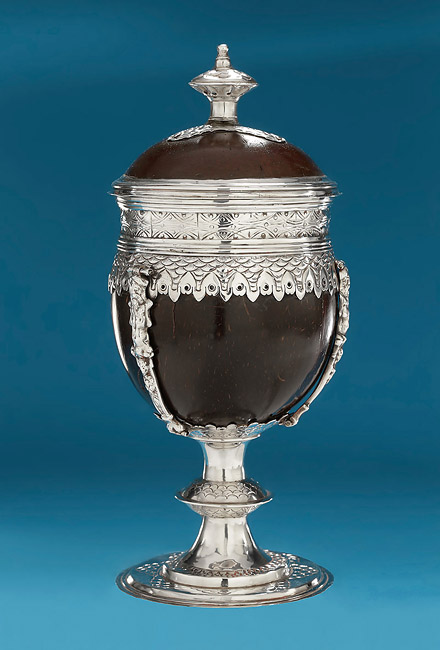
18th Century Silver-Mounted Coconut Cup and Cover
Unmarked to the Body, Cover Maker's Mark Rubbed, Probably Continental
The silver-lined ovoid bowl having silver mounts with fish-scale diapering & pierced border,
supported by three silver Atlanteans over a knopped pedestal stem
and stepped base, also with scale diapering,
the coconut cover with knopped silver finial and escutcheon
10" High
SOLD
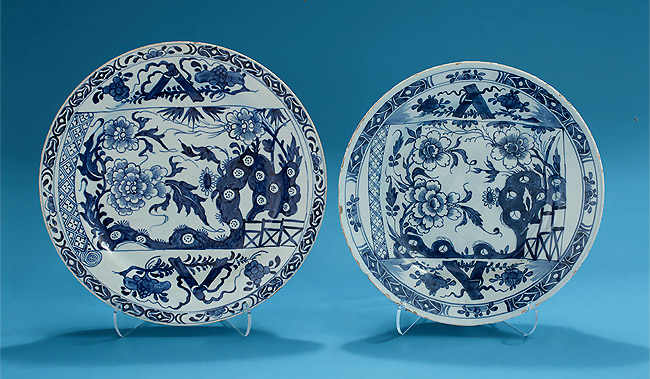
Bow Scroll Pattern Plate, & Dublin Delft Scroll Pattern Plate, after the Bow
England, c1750-2, & Ireland, c1755-60
The Bow an exact copy of a Chinese export original;
Bow example exhibited English Ceramic Circle 1948, with label and reference number 154;
(The above plate is cited in Bow Porcelain, Geoffrey Freeman, p.57, Pl. 67. as "the Toppin example",
with reference to "E.C.C. Catalog 1948, pl. 34, no. 154");
for further discussion of this plate, see Bow Porcelain, Adams & Redstone, p.87-8, Pl. 19
Bow influence on Dublin delftwares discussed Irish Delftware (2000), Francis, pp. 105-6
9.25" & 8.75" Diameter
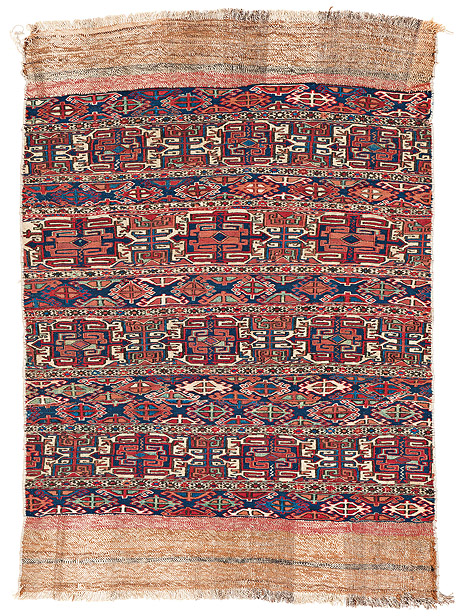
Fine & Rare Antique Bijar Soumak with Full Kelim Endings
Persia, c1900
Very finely woven,all vegetal dyes and wool warp and weft;
Original long kelim endings
4'10" x 3'6"
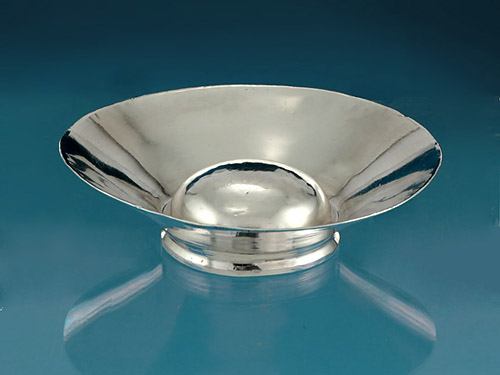
Louis XV Provincial Silver Wine Taster
Jean-Francois Jouet, 1765-66, Bordeaux, France
The form characteristic of the province of Bordeaux,
having a shallow round circular bowl with tapering sides
and a high domed center rising above the rim, raised on a 'collet foot'
4" Diameter / 2.25 oz
SOLD
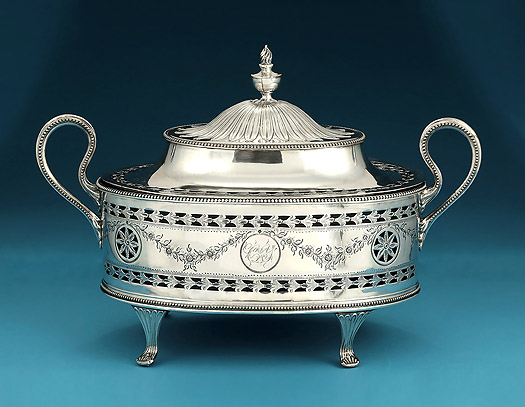
Rare & Fine Old Shefffield Plate Butter Tub & Cover
Tudor & Co., England, c1780
With star cut blue glass liner, the center medallion engraved in script CY,
as well as the cover interior, the cover interior and base also engraved Y over I*S;
star-cut blue glass liner
Literature : Old Sheffield Plate : A History of the 18th Century Plated Trade,
Crosskey, op cit. p.382
6.5" High x 9.25" Over Handles, 4.5" Deep
SOLD
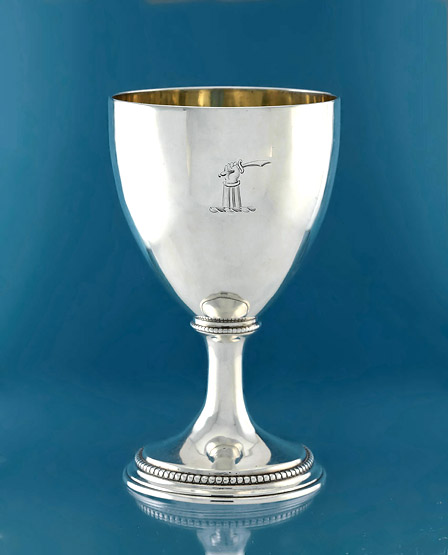
John Swift, London, 1799
The ovoid body crested for Jolliffe (Somerset) :
a cubit arm erect, vested and cuffed,
the sleeve charged with a pils arg., holding in the hand a scimitar
inscribed beneath the foot for a marriage :
H over I * M and 1780;
gilt interior and beaded collar and footrim
6" High / 7 oz.

SOLD
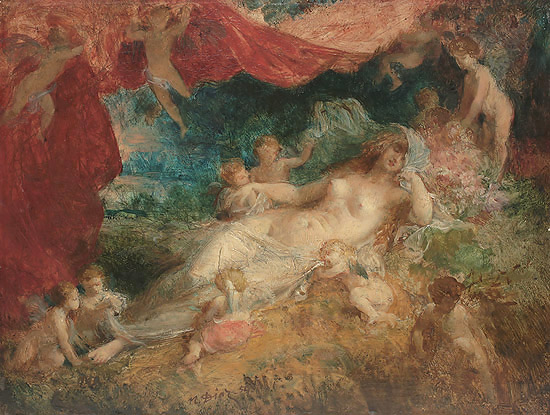
Narcisse Virgile Diaz de la Peña
(French 1808-1876) (Attr.)
Oil on Panel over Pencil
Signed Lower Center N. Diaz and dated 54
Exhibition of the French Masters, 1951, No. 18; Marlborough Fine Art, London
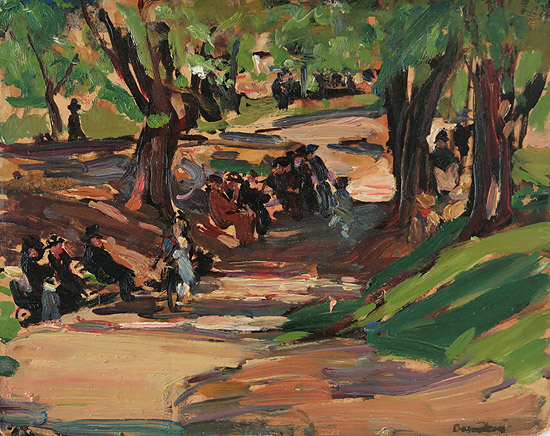
Theresa Ferber Bernstein
New York / Massachusetts (1890-2002)
"Sunny Path, Central Park, c1917"
Oil on board / Signed lower right
Image Size : 9" Wide x 11.5" High
Exhibited: New York : Empire City. Grand Central Art Galleries, New York, bearing affixed paper label verso
Boldly painted in directional impasto manner, this small figurative image depicts life in Central Park in the early 20th century. The strength of the work is exactly what Ms. Bernstein was so well known for : "rapid, fluid brushwork, innovative color play, and fresh approach"; "plein-air landscape painting with startling color contrasts and bright accents of light". The combination of energetic contrasts of light, line, freedom and precision in the work are completely arresting, as well as the simple examination of life and activities in a more romanticized era gone by - executed with passion but without sentimentality.
Ms. Bernstein lived to be 111 years old. A member of the Ash Can School as early as 1910, she continued to produce "vibrant canvases" for 8 more decades. We are pleased to offer this exceptional "vibrant canvas".
SOLD
|
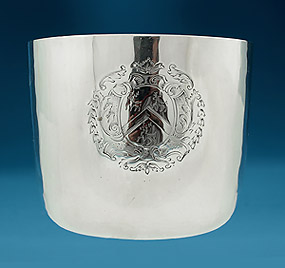
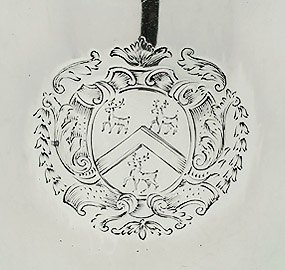
William & Mary Silver Tumbler Cup, London 1692
IC in a shaped punch, a mullet below
(Jackson's Revised, p.137, as found on 2 tankards, 1685-6, and a toy porringer 1691-2)
Bearing arms for the family of Rogers (Rodgers, Roger)
2-7/8" High, 3-3/8" Wide / 4.8 oz
SOLD
|
|
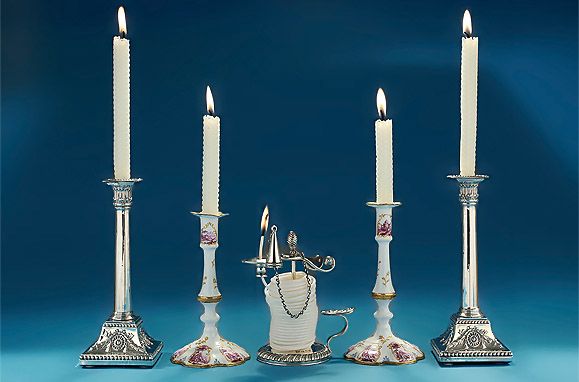
Pair 18th Century Silver Neoclassical Tapersticks Pair c1760-5Sheffield England, or possibly Continental Unmarked to the silver, bird in flight in the nozzle interior; tests as silver 7.5" High
Rare & Fine Pair of South Staffordshire Enamel on Copper Tapersticks England, c1760-65With exquisite and detailed en camaieu puce 6.5" High
George III Silver Scissor-Form Wax Jack S. C. Young & Co., Sheffield, 1815 Of finest quality, marked to body and snuffer Crested : a greyhound's head, couped & collared (Fairbairn's 61.2) 5.5” High / 6.2 oz. (SOLD)
|
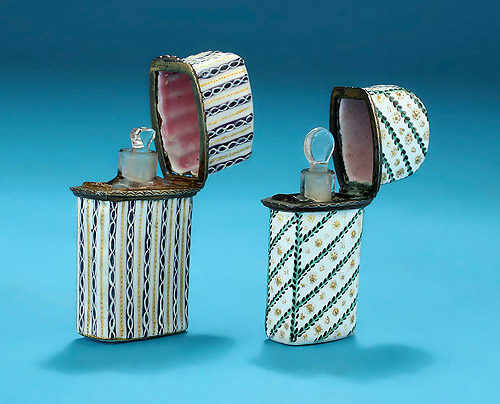
Two South Staffordshire Enamel on Copper Scent Flasks
England, c1775
With Original Cut Glass Stoppered Bottles
2.5 adn 2.25" High
Previously with Manheim NYC
SOLD
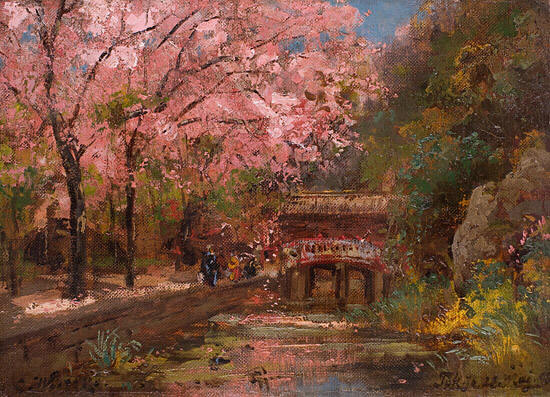
German (Munich) 1849 - 1927
Park in Tokyo During The Cherry Blossoms
Oil on canvasboard / Signed l.l. / Panel size : 7 5/8" x 10 7/8"
Titled l.r. "Tokyo” and dated “26.05.(18)98."
In 1897-99, Carl Wuttke undertook a world tour, during which he visited China and Japan. In Tokyo in 1898, he painted the
above cherry blossoms in bloom. This small jewel-like painting is in the best of Wuttke's style, executed with spontaneous and
energetic brushwork, and with luminous colors. There are areas of absolutely brilliant impasto work, uniquely imbuing the Munich
School with the brushwork of French Impressionism. It is perfection at all
levels, and enchanting to view.
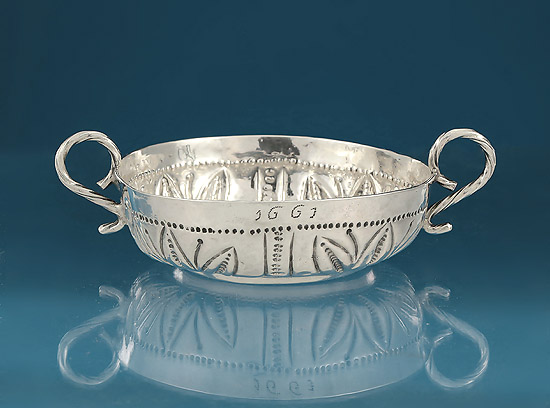
Charles II Silver Wine Taster
Prick-Engraved "1661" & "H over I.A"
The shallow circular bowl chased with tulip floral and leaf decoration,
the sides with leaves and the center showing the upright bloom sided by leaves.
the sides with clipped twist handles
4.5" wide / 1.52 oz.
SOLD
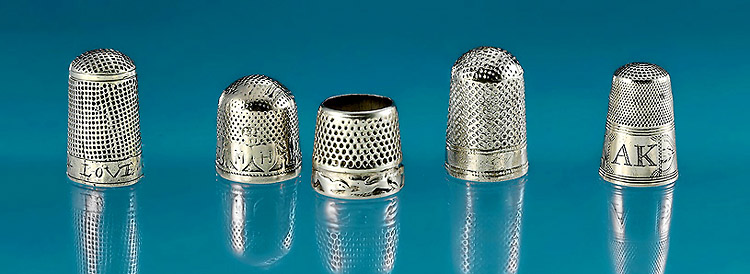
Summer Stories : A Tale of Thimbles
Five Silver Thimbles, dating from 1620 to c1770,
and written to be shared with children.
It also features children's fashion concurrent with the timbles dates.
SOLD
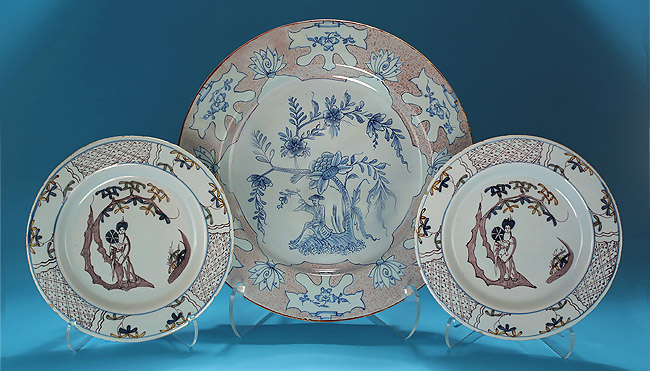
Pair of Bristol Manganese & Polychrome Plates
England, c1740-50
9-1/8" Diameter
Ref : An identical plate is shown in "Delftware in The Fitzwilliam Museum", Archer
Good English Delft Manganese & Blue & White Woolsack Charger
Probably Liverpool, c1745-55
14-1/8" Diameter
Provenance: Garry Atkins, London, March 1993
*"Woolsack" refers to a sack containing wool, as well as the official seat of the Lord Chancellor in the House of Lords.
While some are of a square tufted form, this 6-tufted version is also somewhat reminiscent of lotus reserves on Chinese porcelain.
 |
 |
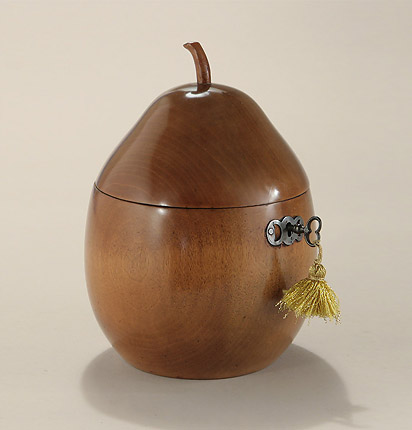
George III Fruitwood Tea Caddy, in the form of a Pear Or large size, retaining the original Key 6" High SOLD
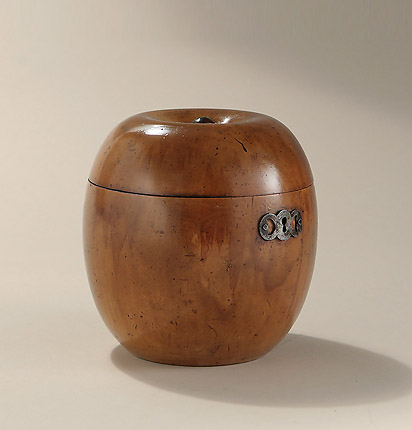
George III Fruitwood Apple-Form Tea Caddy Of large size, with steel eschucheon England, c1790-1810 4.5" High SOLD
Perhaps there is no better symbol for the English Yuletide "wassailing of fruit trees" than the turned fruitwood tea caddy. Introduced in the late 18th century, these fruit-forms are today probably the most sought-after of all caddies. There is conjecture that these caddies were made in imitation of the early 18th century Chinese pears and aubergines. English (and German)
examples were predominately apples and pears; the European models were simply polished or varnished, having loosely fitted hinged lids that were lifted by means of a stalk - many of with have been broken or lost. The interiors were lined with foil, now softly disintegrated through years of use. Such is their popularity that many imitations are still made today,. However these caddies date from the late 18th or early 19th century English Georgian period.
|
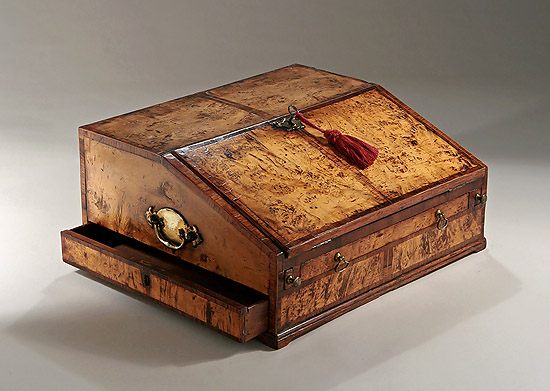
Rare Queen Anne Stained Burr Maple and Kingwood Traveling Bureau
England, c1710
|
The burr maple veneer “stained” in lampblack to resemble tortoiseshell – in the manner of cabinetmakers John Coxed and Thomas Wooster (1690-1736) – banded to the edges and center with kingwood, the surfaces radiant and now softly faded to a glorious color; having a rectangular top above a sloping fall (with original lock and key), and opening to a veneered surface and green morocco-lined recess, the sides with brass carrying handles; the lower section with a pull-out dressing mirror flanked by rectangular lopers, having a shallow drawer fitted for two inkwells to one side, the other side with a vacant deep drawer, the whole raised on a moulded plinth above shallow bracket feet
Lampblack “stained” maple or elm is often referred to as “mulberry”. Most “tortoiseshell-like” surfaces, and likewise the small bureaus, were produced by John Coxed, and Coxed and Wooster from c1700 through 1720, most c 1705-10.
SOLD
|
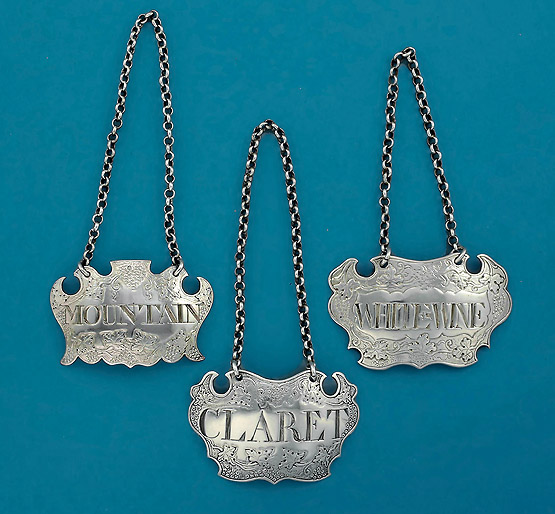
Three George II Silver Escutcheon Bottle Tickets, c1739-50
'MOUNTAIN' James Slater, London, 1739-50 (SOLD)
'CLARET' Thomas Rush, London c1740
'WHITE.WINE' William Cripps, London, 1743-50
Each Priced Separately
("Mountain" is a fortified dessert wine, sweet and dark, from the Malaga area of Spain.
It was very popular during the whole of the 18th century, but rarely found later.)
"Wine Labels", E.W. Whitworth, p.55
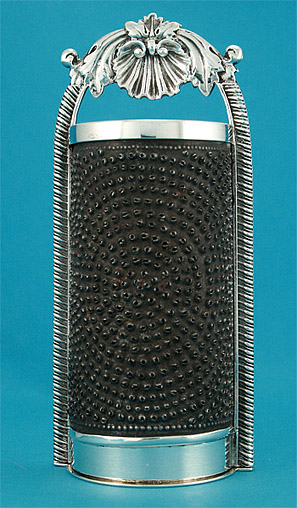 |
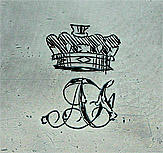
Thomas Phipps, James Phipps II Edward Robinson II, London, 1812; Royal Coronet over AF Most likely for Prince Augustus Frederick, Duke of Sussex
Of heavy gauge, the mounted curved blue steel body sided by gadrooned uprights and a shell and foliate handle, the lower end hinged and monogrammed with a coronet above conjoined initials "AF"; fully marked on body and lid.
4-5/8” High / 3.8 Oz. SOLD
|
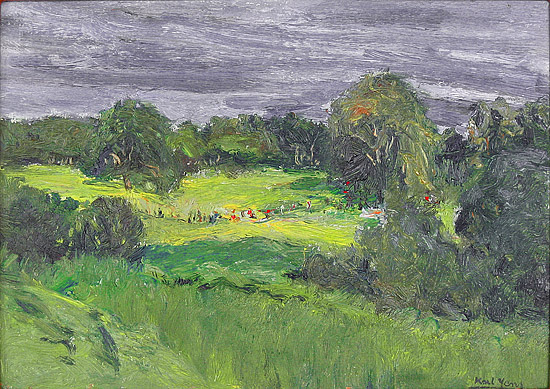
German / American / California, 1868-1945
The Famous Jenisch Park, Elbe Germany, 1931, Oil on Panel, 10" x 13"
Provenance : Laguna Beach Museum of Art, Laguna Beach CA
Karl Julius Yens immigrated from Germany to Southern California in 1901,
and was one of the early Laguna plein air painters.
This scene, however, was done on a return trip to Hamburg in 1931.
It was deaccessed from the collection of the Laguna Art Museum,
and bears the historical information from the Laguna Museum verso.
The frame appears to be original.
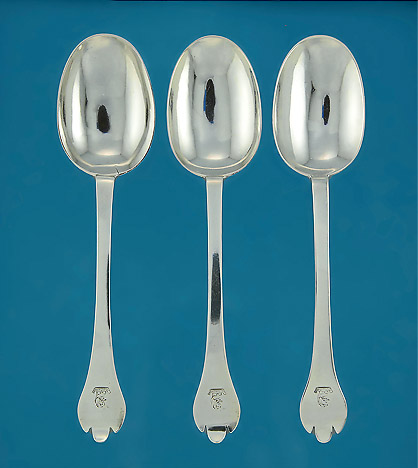
Matched Set of 3 William & Mary / William III Trefid Spoons
Francis Archbold, 1699 ;1692, mark rubbed, poss. Archbold ; 1694, John Cory
Each crested en suite : a talbot’s head out of a mural coronet
(Amory - Somerset or Co Clare, Ireland; South Carolina Interest):
7 5/8" Long / 4.5 oz.
|
Trefid spoons are the first form of the modern spoon, the earliest trefid being recorded in 1662. They became more common in the 1670’s, only being made until c1700. During the 17th century, even the wealthy usually possessed only one silver spoon, and would carry it about on the person when traveling. This set of three spoons was assembled in the late 18th or early 19th century, and bears the crest of the collector. Francis Archbold and John Cory both shown to be working concurrently at the "signe of the Golden Cupp" - Cory from 1697-1722, and Archbold c1700. |
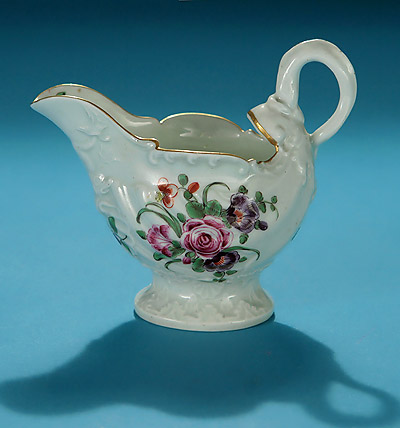
First Period Worcester Dolphin Ewer Creamboat
England, c1775
The small shell molded body and a biting lamprey handle, having two entwined dolphins below the lip,
painted in polychrome enamels with floral sprigs in the “Compagnie des Indes” manner,
the footrim with various shell and lambrequin moldings; gilt edged rim
Several factories produced versions of the “Dolphin Ewer”, mostly in blue and white. Worcester examples
date from the late 1760’s with the molding picked out in bright colors. Later examples with formal
enameled flowers are uncommon at Worcester; however, Lowestoft examples are more plentiful.
3-3/8" High x 4" Long
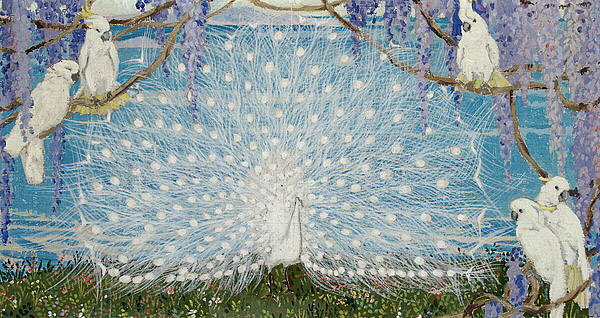
Jessie Arms Botke
American (Illinois/California) 1883-1971
“Carmel by the Sea, Peacock and Cockatoos”
Oil on Canvasboard
Signed and titled verso: Jessie Arms Botke, Carmel by the Sea Calif.
Provenance: Gifted to the family from the artist
Panel Size: 6.5" x 12"
Jesse Arms Botke discovered the peacock when commissioned by the Herter Looms (NY) to paint murals for Billie Burke's home
at Hastings-on-the-Hudson. She had not seen peacocks before, first discovering them at the New York zoo. "It was love at first
sight and has been ever since," she recalled. She later stated, concerning her love for birds:
“My interest in birds was not sentimental, it was always what sort of pattern they made, and the white peacock was so
appealing because it was a simple, but beautiful white form to be silhouetted against dark background, and the texture
and pattern of the lacy tail broke the harshness of the white mass without losing the simplicity of the pattern.”
The work of Jessie Arms Botke is represented in many major collections and museums, including The Art Institute of Chicago,
The Carnegie Art Museum, The Irvine Museum, and The Norton Gallery of Art. Her murals are housed in the University of Chicago
and the Oxnard California Public Library.
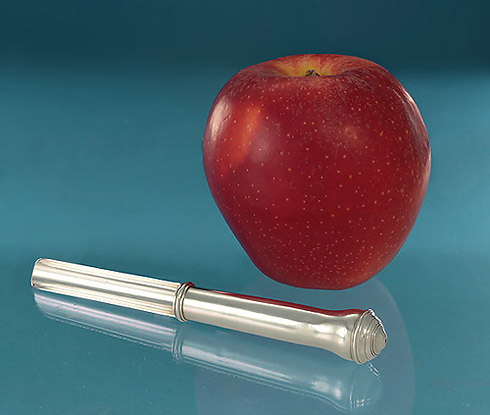
Scarce George II One-Piece Silver Apple Corer
England, c1740-50
The pre-1750s one-piece form of good gauge silver and usual cylindrical form,
the blade of conforming half-circular shape,
the central girdle and bulbous end with incised concentric lines;
marked to the junction between corer and haft with T (device) H beneath a crown
SOLD
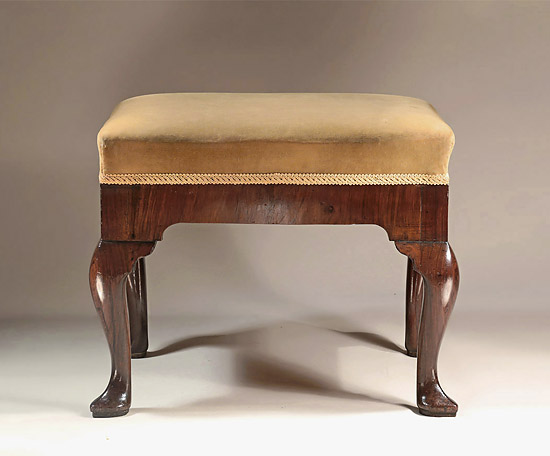
George I / II Walnut Upholstered Stool
England, c1720-40
The rectangular shaped seatrail raised on four cabriole legs
having shaped returns and ending in pointed and slightly upturned pad feet,
surmounted by a padded velvet-upholstered seat
16.75" High x 20.5" Wide x 16.5" Deep
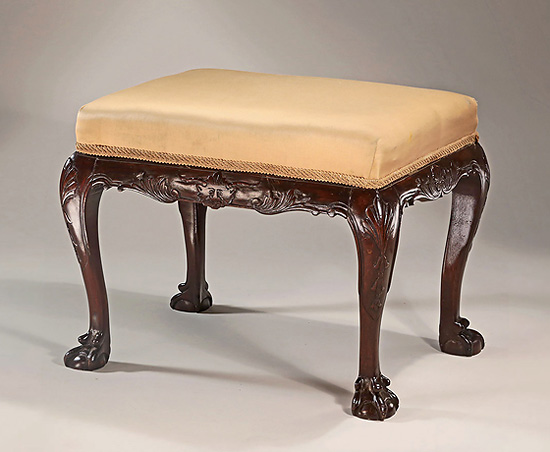
George II Irish Carved Mahogany Stool
Ireland, c1740
The deep convex apron centering a Celtic 'green man' mask
raised on four shell headed cabriole legs
ending in ball and claw feet below protruding 'fetlocks'
15" High (The Frame), 16.5" to Crest, x 21" Long c 15.5" Deep
SOLD
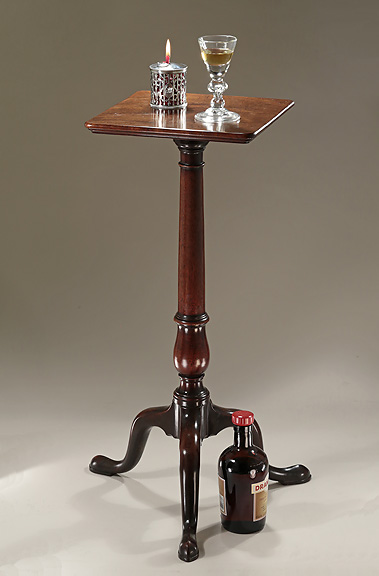
A Good George III Cuban Mahogany Candlestand
Probably Scotland, (Francis Brodie), Taymouth Castle & Holyrood, c1765
the base verso bearing the remains of a paper label :
('BROUGHT TO TAYMOUTH FROM THE MARQUIS OF
BREADALBANE'S APARTMENTS AT HOLYROOD, MAY 16, 1860')
30.25" High; 12.25" Square
SOLD
Shown With a
Queen Anne / George I Heavy Baluster Small Wine Glass, England, c1710-20
and a
George III Pierced Silver Bougie Box, Edward Aldridge II, London 1768
|
To view additional Special Catalogs, please click below:
|
|
||
|
||
|
|
||
|